Saturday, June 24, 2006

The Ebstorf mappamundi


I don't post regularly, but I thought that I would share this. I've recently been reading Peter Candler Jr.'s Theology, Rhetoric, Manuduction, or Reading Scripture Together on the Path to God (quite the Hauerwasian title; it's no wonder that Stanley is the editor of the series!) and he opens his book with a short reflection on this 13th century map found in the middle of the 19th century. After reading his reflection, I thought I would share it here on my blog:
In a thirteenth-century map of the world discovered in 1830 in the Benedictine Abbey of Ebstrof, the whole of terrestrial creation is pictured, in typical medieval fashion, as a circle, with Jerusalem as its center. The entire image is, as it were, superimposed on the body of Christ, whose extremities represent the directions of the compass: the head of Christ in the east, his hands at north and south, and his feet marking the west. Looking at this map, one is forced to orient oneself not according to modern standards of objectivity, but, one might say, as a reader. After all, the map is structured as a complex organization of narratives, with what now seems like bizarre and superfluous information not found on modern maps of the world: architectual structures, animals, human beings, and text.

It quickly becomes apparent to the modern observer that to make sense of the Ebstorf mappamundi, it must be read. It cannot simply be seen and understood; its foreign idiom must somehow be taught, learned, and inhabited....In other words, it suggests a mode of reading which is less the comprehension of a tableau that the performance of a sequence of movements.

Yet it also seems to indicate that to read the world rightly is to read it in Christ, and that the world itself is rendered intelligible only by seeing it as a kind of diaphonous veil which simultaneously hides and discloses the God who creates it....All of creation, it is implied, gathers its meaningfulness from its orientation to Christ the head, the only true agent of knowledge.

What I find very stimulating from Candler's reflection is the dislocation and disruption of the modern reader and modern 'textuality'. For those of us who teach, or will teach, theology to young, budding minds, this reflection might prove very useful in the classroom. Needless to say, I'm anxious to keep reading!

Wednesday, May 10, 2006

Jüngel on Divine Omnipotence


"The metaphysical theory of the worldly omnipresence of a God who is above everything and nowhere corresponds much too much to the fixation of God as a supra-worldly 'above us'. The faith that the 'Father in heaven' above us was among us through the crucified Son of God and in the Holy Spirit is united with the Son not only for himself but as one absent is present with us and that as the one who 'lets himself be pushed out of the world' comes to the world--this faith grants to the theologoumenon of the omnipotence of God a meaning which reconstructs it entirely. This happens in that God's omnipresence is to be understood now on the basis of his very presence on the cross of Jesus and not without a christologically established removal of God. The concept of the omnipresence of God must pass through the eye of the needle of the properly understood concept of the death of God."

~ Eberhard Jüngel, God as the Mystery of the World (Eerdmans, 1983), 63.

Tuesday, May 09, 2006


John's Christ

"John's designation of Christ as the Logos points to the fact that the evangelist envisions him as fulfilling the role of cosmic reason, in the Greeks' and in Philo's sense as that which grants all things their intelligibility. The subsequent events of the Gospel reveal, however, that John does not seek to demonstrate this by projecting the life of Jesus onto the level of Greek wisdom (or vice versa), but rather allows the incarnate Logos to interpret himself. The Logos reveals himself as 'gracious love' (karis), and thereby as 'glory' (the 'divinely beautiful', doxa), and precisely for this reason as the 'truth' (alethias). It therefore becomes possible to arrive at an intelligibility that illuminates the pure facticity of the historical as a necessity, and at the same time an intelligibility that cannot be reduced to that which the human being demands or (for whatever reason) anticipates."

~ Hans Urs von Balthasar, Love Alone is Credible (Ignatius Press, 2004), 54-5.

Saturday, May 06, 2006

The following is a paraphrase of Eberhard Jüngel's God as the Mystery of the World pp. 184-225.

The necessity of thinking God together with perishability is the final turn in the disputation with the metaphysical tradition. There is a double necessity for this thought: first, an objective necessity is given through the Christological exposition of the biblical tradition and second, it is required as a consequence of the historical consciousness which has grown out of modern metaphysics. In the structure of modern metaphysics, to exist means to be perishable. Theology must raze the metaphysical God who is supra nos by positing that God’s essence is his existence (as a non-contradictory unity) such that he is understood to be subject to perishability, since he indeed exists and does so within the dimension of historical factuality so that this dimension is the undisputable location of the thinkability of God’s unity with perishability. More precisely, Christian proclamation trustfully and faithfully speaks of the unity of God with the executed Jesus of Nazareth so that it discovers God and humanity already together in Jesus Christ—God’s unity with perishability is God’s subjecting his glory in Jesus Christ to perishability for the sake of perishing humanity (kenosis). Faith acknowledges this reality and in so doing is the precondition for the thinkability of God since it preserves the identity of God’s being and existence—it takes God’s existence (which is an existence subjected to perishability) as his being. It is faith, not as a function of anxious self-security, but as a joy and trust in God—an event which eradicates the need for self-security such that the human being is not insecure but certain (since trust is the certainty which removes security) and free in its relationship to God.

The possibility of thinking God’s unity with perishability is sought within the historical situation of modern thought—this brings us back to the talk of the death of God. Either theology thinks God’s unity with perishability in such as way that God and faith belong to the past and that atheism rules the day, or it thinks in such a way that God and perishability and their relation must be re-thought. Within the structure of modernity one cannot think of perishability and God together without doing away with the metaphysically conceived deity. In its thinking of perishability, modernity has cast it in an entirely negative light, so that even the possibility of conceiving of God coming together with death was ruled out—the metaphysical God cannot tolerate perishability. On the other hand, and with some clarity, Nietzsche asserted that perishability could not tolerate God (the Pauline ‘God on the cross”)—yet in the end, Nietzsche was bound to metaphysics in that he considered perishability abstractly. Therefore, in order for theology to speak clearly about God’s unity with perishability, about a God who is in heaven in such a way that he can identify himself with the poverty of the man Jesus, it must attend to this unity with renewed precision. Perishability, in its negative aspect as a simile of the tendency toward nothingness conceals its positive in its inherent possibility, which is given ontological primacy over Aristotelian ‘reality’ so that possibility is the ontological plus of being, that is, it is capable of becoming, and not a deficiency in reality. Perishability is understood then to be the struggle between possibility and nothingness.


The language of the death of God would then imply that God is in the midst of this struggle. Based on the word of the cross, as the One without whom nothing is (including perishability), God is not the Creator removed from struggle but is rather the creative being involved in the struggle against nothingness which precipitates a hermeneutical priority to the word of the cross. God has involved himself with nothingness in the form of a struggle in which he shows nothingness its place by giving it a place within the divine life, whereby in bearing annihilation within himself without himself being annihilated, proves to be the victor over nothingness and gives to nothingness its determination as concrete negation. Yet as the one who identifies himself with the dead Jesus, as the one who suffers endlessly, God is the one who exists for others and does so by defining himself as love on the cross of Jesus. God is in and of himself in such a way that he is for humanity. This is not to be understood as an inner necessity but as an un-coerced freedom of God’s self-definition with the man Jesus so that just as love for us, God is love in and of himself. Because God is love, he counters nothingness and not vice versa. We grasp the being of God then as a Going-Out-Of-Himself into nothingness—this is his essence—and his existence as this essence is an existence marked not by standing outside of nothingness but standing into nothingness. In his going out of himself, God is the One who remains in the process of becoming, going into nothingness and yet going in such a way as always coming from himself. God’s activity ad extra which is his being as becoming is the work of God ad intra, his existence is his essence and he is thought, and only thought, in his unity with perishability.

Saturday, April 22, 2006

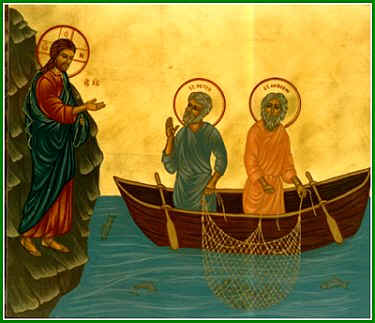
Jesus calls Peter and Andrew

Matthew 4:18-20
As he was walking by the lake of Galilee he saw two brothers, Simon, who was called Peter, and his brother Andrew; they were making a cast into the lake with their net, for they were fishermen. And he said to them, ‘Come after me and I will make you fishers of people.’ And at once they left their nets and followed him.

Commentary:

In this passage we have the narrative of the calling of the first disciples. Here we have a Jesus who not only came to teach, work some miracles, get crucified and then rise. He did more than that. His works are uninteligible apart from the economy of the calling, upholding and sending of the apostolate. The economy of the Son is an economy wherein he came and made disciples, he made followers. Reading this narrative we can ask then, “what makes Peter and Andrew disciples?” Was it something Jesus saw in them, some potential he could see beneath the surface? Certainly not; after all they were just simple fishermen. What Matthew is underlining for us is the power and potency of Jesus’ Word, not Peter or Andrew’s potential. Jesus says, ‘Follow me’ and immediately they drop (aphentes) their nets and follow. Earlier we meet this in the Greek in Jesus’ encounter with the Baptist and with Satan. When Jesus says to John ‘let us’, John ‘let’ and when Jesus said ‘leave’ Satan ‘leaves’ (aphentes). Luther’s words are apropos: “When this Speaker saith something that He will have, it must be so”.

In the Rabbinic tradition, ‘follow me’ meant “come, be my students, be apprenticed, join my school.” Ordinarily, students would seek out rabbis or teachers. But this rabbi is also Lord. He seeks out his followers. No one comes to this one by one’s own initiative. This one, whose identity is the self-same Johannine “Lamb of God”, the “Messiah”, calls and so comes to them first: “you have not chosen me, but I have chosen you” (Jn. 15:16). Barth notes that this passage, “this first calling” stands in direct connection with the beginning of Jesus’ proclamation of the fulfilled time and the immanent kingdom of God. So Barth:
Throughout the Gospel narrative which follows, this prophetic action will always be His, and will consist in words personally spoken and deeds personally performed by Him...when Jesus Himself makes his debut as Prophet, His call to discipleship implies commissioning to their own future speech and action. Hardly has His own Word gone forth concerning the fulfilled time, the kingdom, conversion and faith, before they must attach themselves to Him and in some sense tread on His heels.
Barth’s words draw us to consider the differentiating and electing will of of the Word by whose power we cease to be what we were and become what we were not: followers of Jesus and in correspondence to his action by his action we too are made to be “people fishers”.
Job with Background of Geometricized Christ à la Cimabuë by Marc Chagall

Many have pointed to Job as a prefigurement of Christ in the tradition of the Suffering Servant of Isaiah. Chagall captures this beyond literary expression. His artistic engagement with Job came late in his work and it may be that he had turned away from the figure of Job until the revelations of the Holocaust compelled him to face not only the scandal of a gigantic evil in the world but also the subtle complex of faith and the revolt within the human soul. This piece was painted ten years before his death and is itself a stark reminder of Christianity’s inseparability from Israel--something Chagall called Christianity to account for throughout his career.

This is the last in a series of Joban interpretations. It was painted in 1975, about ten years before Chagall’s death. Chagall, as a Jew, understood what a Christian theology of suffering should look like better than some Christian theologians do. What he so boldly realizes is that in considering the reality of suffering and the reality of Job’s God, we cannot speak of, or more properly visualize, suffering apart from the suffering God found in the narratives of the New Testament.

In this Joban interpretation, suffering abounds. Job the sufferer stands up close as the Jewish peasants—fathers, mothers, infants, and children—look to him with both lament and hope. Job’s wife is given a prominent role which, we should note, is an extrapolation from the text itself. This is because of the strong role of women in his own life. In a sense, he’s rescuing her identity from the obscurity it has in the narrative. It is actually a Marian interpretation, a suggestion of the suffering of the mother of Jesus. Directly opposite Job rests the Crucified one. He is faint in the distance, an echo of the Joban drama directly before us. The crowd in the background are similarly involved as those in the foreground. They look to Christ as they do to Job—with expectation. The angelic messenger, with open scroll, is suspended above both dramas demonstrating the Divine presence over both narratives. The unity of the drama is undeniable. The light of the angel contrasts with the darkness surrounding Golgotha. Yet the light is not eclipsed by the darkness, nor the darkness totally eclipsed by the light (I am indebted to Samuel Terrien's wonderful meditation upon this painting in his The Iconography of Job Through the Centuries, Penn State Press, 1996).

The Joban narrative points us to the drama of the One who suffers pro nobis, for us. Chagall brilliantly depicts this. It is in witnessing to the suffering servant of YHWH narrated in the gospels that the book of Job finds its true place. Ours is the same drama. We suffer and bemoan, lament and curse, and legitimately so. We plead for a response. We are indeed surprised that we have been engaged “out of the whirlwind” and our transformation results in our faithful and trustful acceptance of and obedience to the One who speaks. The one who rules from a cross. Our theology and language of suffering ought to begin here as, like Job, we lay our hands over our mouths and yet are driven to speak: “We had heard of you by the hearing of the ear, but now our eyes see you.”